Implemented in the software prototype
Mission coordination, formation behavior, area-coverage planning, fault scenarios, telemetry, and run recording form the current development baseline.

Project / ZERGIIE's
ZERGIIE's is MDNT's R&D platform for coordinated micro-autonomy. Its current software prototype brings mission planning, formation behavior, area coverage, and telemetry into one environment for developing and examining multi-agent behavior.
System overview
The project explores how small autonomous units can work as a coherent system: how a mission is defined, how agents are assigned, how formations and coverage patterns are coordinated, and how the operator can inspect what is happening.
The current prototype concentrates on the software layer. Simulation makes it possible to repeat scenarios, introduce faults, and examine coordination behavior before transferring assumptions into physical hardware.
Prototype capabilities
The current prototype keeps mission intent, assigned agents, progress, controlled changes, and recorded evidence visible to the operator.
Define missions and coordinate their execution through a shared runtime, with mission state and agent participation visible to the operator.
Create formation arrangements and examine how agents take positions, follow coordinated movement, and respond when participation changes.
Define an operating area, generate sweep geometry, and partition coverage work across participating simulated agents.
Explore how coverage plans and coordinator assignments respond to changing agent availability, with recovery and staffing behavior under continued stabilization.
Use operator commands and logical communication faults to examine intervention, degraded behavior, and recovery within the simulation.
Inspect agent and mission state during execution, then use recorded run data to support analysis and comparison of observed behavior.
Inside the prototype
The prototype connects mission intent, coordinated execution, and run evidence in a single development workflow.
Set the mission, formation, or area to be covered.
Allocate work and follow agent participation and mission progress.
Introduce a controlled fault or change and inspect the system's response.
Examine telemetry and recorded run evidence to understand what happened.
Authentic prototype evidence
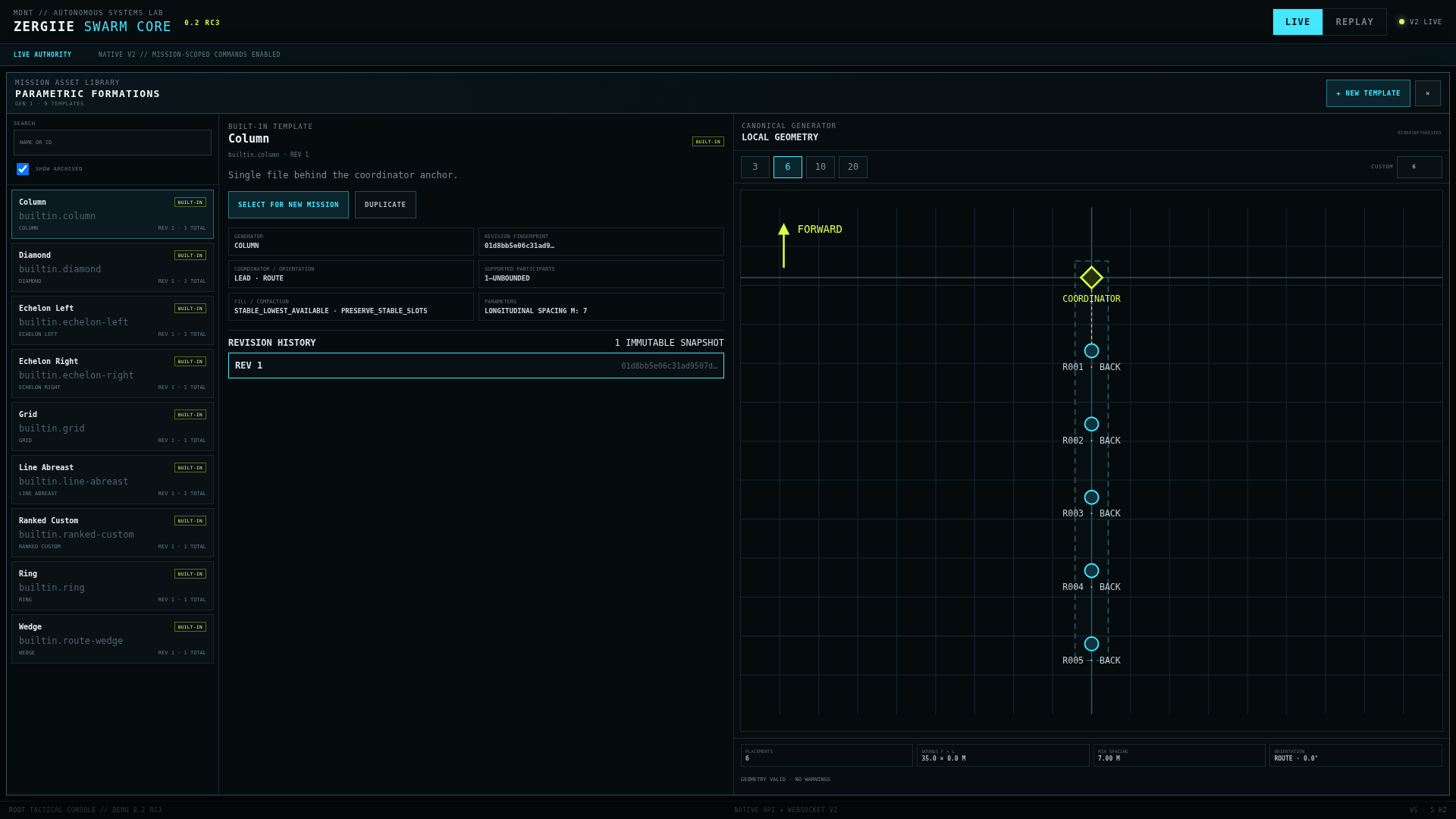
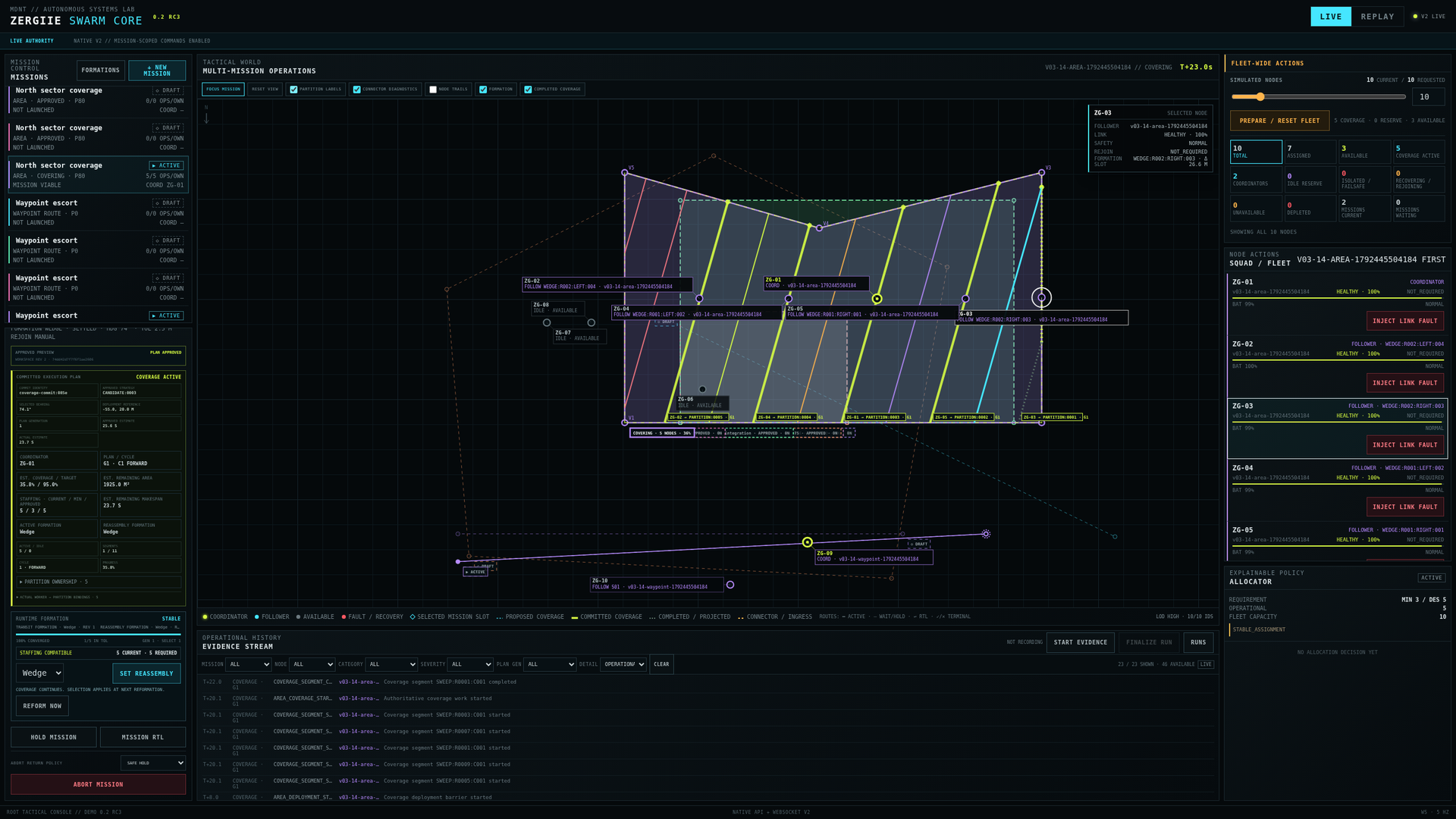
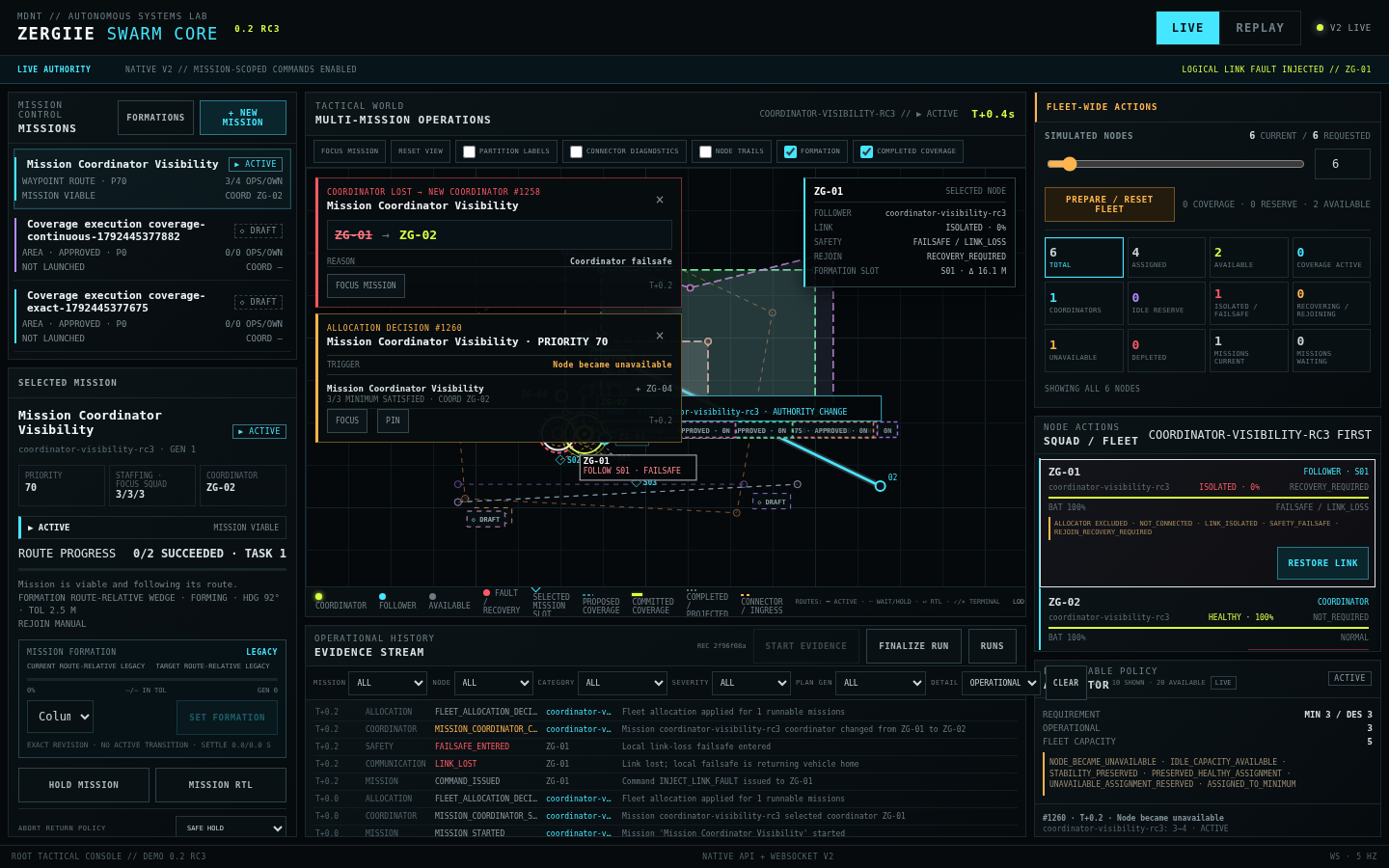
These authentic interface captures show formation definition, coverage execution, and a fault response as exposed to the operator. Each view is software simulation, not physical operation.
 Open full-size capture
Software prototype — formation library with a six-placement column preview anchored to a coordinator.
 Open full-size capture
Software prototype — active coverage with five assigned simulated nodes, partition boundaries, and committed sweep segments.
 Open full-size capture
Software prototype — mission-scoped coordinator change from ZG-01 to ZG-02 after a logical link fault, with ZG-01 in FAILSAFE.
System model
An operator-facing interface defines intent and exposes system state. A shared application runtime coordinates simulated agents, while telemetry and run artifacts preserve observations for later review.
This structure lets the project develop mission behavior, operator interaction, and evidence handling together while physical integration remains a separate future validation stage.
The operator interface sends mission intent to one authoritative mission runtime. The runtime coordinates simulated agents and sends observations to telemetry and run records for later review. Physical platform integration is shown separately as future work.
Current: one authoritative software runtime makes competing mission assignments explicit.
Future: hardware, communications, and field behavior require separate validation.
Development status
Mission coordination, formation behavior, area-coverage planning, fault scenarios, telemetry, and run recording form the current development baseline.
Allocation behavior, coverage continuity, recovery, and mission lifecycle transitions are being exercised and refined as the demonstration matures.
Physical platform integration, communications testing, and controlled field evaluation will test which assumptions hold outside simulation.
Application directions
Intended application areas include environmental sensing, infrastructure inspection, local situational awareness, and research into coordinated autonomous systems. These directions guide prototype development; they are not claims of completed field deployments.
Collaboration
MDNT is open to focused technical collaboration around mission coordination, embedded integration, communications, simulation scenarios, and controlled evaluation environments.
Discuss ZERGIIE's20F4 1435 3E7E A1A6 7EC0
EA11 8DFF F119 FF5B 8464
-----BEGIN PGP PUBLIC KEY BLOCK-----

xjMEalDKCRYJKwYBBAHaRw8BAQdAgNOFm8pBHMT/aRdKjxiGKat9yaTZQV0B
jtic3+tSzvzNG2xhYnNAbWRudC5wdCA8bGFic0BtZG50LnB0PsLAEQQTFgoA
gwWCalDKCQMLCQcJEI3/8Rn/W4RkRRQAAAAAABwAIHNhbHRAbm90YXRpb25z
Lm9wZW5wZ3Bqcy5vcmckEPEU0W1M01ix+48GvMHDz07lTXtJZ2ZP7vr8QTU/
9QMVCggEFgACAQIZAQKbAwIeARYhBCD0FDU+fqGmfsDqEY3/8Rn/W4RkAAAN
lwD/Qq5jmcu9TiEyNexgqRAb4hWSEHxBJIdEkMWIxeeRuYkA/0yZzdoxKuUl
OrvWQr6YaJZkxlh/dzc6d1L6mLvnH5wBzjgEalDKCRIKKwYBBAGXVQEFAQEH
QLvXLPszOZ6egFG8N3wRJ6h5blm164WpNfTJviOrYEp4AwEIB8K+BBgWCgBw
BYJqUMoJCRCN//EZ/1uEZEUUAAAAAAAcACBzYWx0QG5vdGF0aW9ucy5vcGVu
cGdwanMub3JnMH+xpvowDplsJoB2TZeF2V4tKCmgfj4RX5635Q1nVwwCmwwW
IQQg9BQ1Pn6hpn7A6hGN//EZ/1uEZAAAEzIBANhXi4zG/UyEFcvhWE8EAnFI
nKIiXzVeCGype1l2/12tAP9Cyekpb4NStGIPCUfPZ87v7YMWCssDXkQaxv74
sqpyCQ==
=zuPU
-----END PGP PUBLIC KEY BLOCK-----